solution

Bethlehem and Youngstown, two major steel producers, accounted for about

21% of the national steel market in the late 1950s, when they proposed to

merge. a. Should the two steel companies have been allowed to merge? Why or why not?

b. According to the companies, Bethlehem sold most of its output in the East, whereas Youngstown sold most of its output in the Midwest. Was this fact relevant? Why or why not?

c. The district court did not allow Bethlehem and Youngstown to merge.

Yet in 1985 (as we saw in problem 1), the Department of Transportation

allowed United Airlines (with about 7% of the service between Japan

and the U.S. mainland) to acquire Pan Am’s Pacific Division (with about

19%). How can you explain this?


"Looking for a Similar Assignment? Get Expert Help at an Amazing Discount!"

solution

The New York State Electric and Gas Corporation fi led a request for a 10.7%

increase in electric revenues. The reasons given to justify the increase were that

the value of the firm’s plant and equipment had increased by $140 million,

operating costs had increased, and investors required a higher rate of return.

a. Why should an increase in the value of the firm’s plant and equipment

result in an increase in the amount of revenue allowed by the Public

Service Commission? b. Why should an increase in operating costs have the same effect?

c. Why should the attitude of investors regarding what they require as a rate

of return be relevant here?


"Looking for a Similar Assignment? Get Expert Help at an Amazing Discount!"
solution

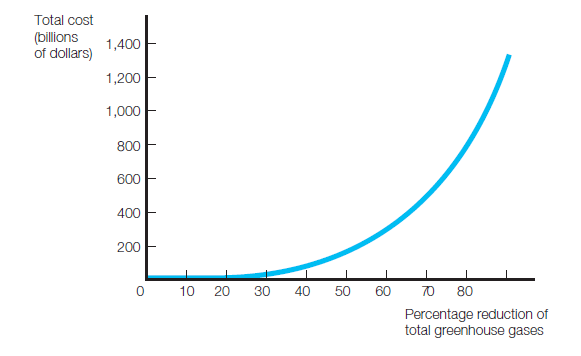
Since early in this century, an enormous amount of attention was devoted to

global warming. According to many scientists, increases in carbon dioxide

and other greenhouse gases may produce significant climatic changes over

the next century. To cope with this potential problem, it has been suggested

that firms reduce energy consumption and switch to nonfossil fuels. William

Nordhaus, a leading expert on this topic, estimated that the worldwide costs

(in 1989 U.S. dollars) of various percentage reductions in the quantity of

greenhouse gases emitted into the atmosphere would be as shown in the following

figure. a. Does this graph show the cost of pollution or the cost of pollution

control? b. Can this graph alone indicate the socially optimal amount of greenhouse

gases that should be emitted into the atmosphere? Why or why not?

c. If world output is about $20 trillion, by what percentage would that

world output be reduced if the countries of the world agreed to cut

greenhouse gas emission by 50%? d. The single most common policy proposed to decrease greenhouse gas emissions is a carbon tax—a tax on fossil fuels in proportion to the

amount of carbon they emit when burned. Why would such a tax have

the desired effect?

Since early in this century, an enormous amount of attention was devoted to global warming....


"Looking for a Similar Assignment? Get Expert Help at an Amazing Discount!"

solution

The cost of healthcare benefits is generally one of the largest people related expenses at any company and is therefore a very strategic part of an overall benefits plan. Healthcare is particularly important in the benefits realm due to recent changes in legal requirements as well as the overall rising cost of healthcare. The SHRM article on “Employers Plan Strategic Changes to Health Benefits”,identifies four different strategies to combat the rising costs of health benefits. After having read this article, rank each strategy according to your evaluation of its potential effectiveness in your organization and also by the ease of implementation (including resources needed, anticipated employee reaction, morale, and any other material considerations.
 
"Looking for a Similar Assignment? Get Expert Help at an Amazing Discount!"