solution

CASE STUDY

The new sales manager

Colleen Pollard reviewed the sales fi­gures for her sales offi­ce for the previous quarter. Results were reasonable, but growth was not as high as in other states, as her boss, the National Sales Manager, has already pointed out to her.
Colleen had been the top salesperson in her fi­rm for the three years prior to being promoted to her current position of Queensland Sales Manager, with a staff of six salespeople and four administrative/ support people, all based in an inner Brisbane suburb. Her salespeople sell components to manufacturing fi­rms throughout the greater Brisbane metropolitan area and product is shipped directly to customers from the Sydney factory and distribution centre.
After completing a science degree, working for the fi­rm in a laboratory role and then providing technical support to salespeople and customers, Colleen had been asked to move into a sales role because of her good interpersonal skills and ability to communicate effectively with customers. Now, after three years in her technical role and fi­ve years as a technical salesperson, she has just completed her fi­rst quarter as a manager of six technical salespeople—fi­ve of whom were her colleagues until three months ago, the other having been recruited by her predecessor just before his retirement (and Colleen’s promotion).
After again reviewing the sales report, Colleen wondered whether she had done a good job as a sales manager in her ­rst three months. Based on sales results, she clearly needed to do even better but she wondered about her priorities. Should she spend more time with the new salesperson? She had introduced this person to her own customers, telling them personally about her promotion while introducing her replacement. The recruit had prior sales experience and did not seem to require much direction or guidance from Colleen. The other five salespeople each had at least several years of sales experience with the fi­rm and seemed to be completely competent.
Colleen checked her diary for the past three months. In the fi­rst month, she had attended a one-week sales management training course and made various joint sales calls to ‘hand over’ her old customers to the new salesperson. In the second month, she had made joint sales calls with the other ­five salespeople to meet all important customers, primarily for customer relationship purposes. She calculated that she had made an average of just one joint sales call per day during the third month. These sales visits mainly related to problems of one sort or another, in which the relevant salesperson believed Colleen should become involved for two reasons; first, to demonstrate management interest, and second, so she could provide advice or assist in resolving the issue based on fi­rst-hand knowledge.
Colleen now wondered whether she should be spending more time observing her salespeople in the ­eld to ensure their sales activities were effective. She had been surprised during the sales management training course to learn that sales managers should be monitoring activities as carefully as results, since she had never had her own sales manager comment on her sales activities. Later discussions with her National Sales Manager had been confusing, since the message seemed to be that Colleen’s promotion had been based on her excellent selling skills—they had been considered vital as they would enable her to assist salespeople to negotiate and close orders. There didn’t seem to be any importance given to assessing salespeople’s activities, just their results.

1 How appropriate are the fi­rm’s criteria for appointing sales managers?

2 How well prepared is Colleen Pollard for her fi­rst sales management role?

3 How effective does her National Sales Manager seem, especially with respect to leadership of the state sales managers?

4 How should Colleen aim to monitor and, if necessary, improve the selling performance of her sales force?

 
"Looking for a Similar Assignment? Get Expert Help at an Amazing Discount!"

solution

CASE STUDY

Buying a new car

Joan and Stan Williams drove their new Subaru Forester out of the Adelaide dealership, happy with the choice they had made.
Three months earlier, they had decided to replace their ageing BMW sedan, partly because it lacked features such as Bluetooth connectivity, cruise control, reversing camera and satellite navigation. They had also decided to buy an SUV, mainly due to greater visibility when driving and ease of getting into and out of an SUV because of its height. After talking to Joan’s brother—a knowledgeable car enthusiast—and reading car reviews, Joan and Stan had decided to consider three SUVs: the Honda CR-V VTi-L, Kia Sportage Platinum and Subaru Forester 2.5i-S. The Forester and Kia models had featured well in a recent RAA review, and Joan and Stan liked the Honda brand, although the CR-V VTi-L had not featured as well as the other two cars in that review.
Initially, they visited three dealerships after work one Thursday evening. At the Kia dealership, the salesperson— whose nametag read Belinda—advised Joan and Stan that sales of the Sportage had been excellent in recent weeks and, consequently, she could not currently show them the model they were interested in. New stock was expected within a week or two. However, the salesperson did show them a similar model and provided a brief comment about the key features. He then took Stan’s contact details and promised to call as soon as the stock arrived.
Feeling somewhat disappointed, as the Sportage was the best-looking of the cars they were considering, Joan and Stan drove to the Subaru dealership. As they parked outside the Subaru dealership, Stan said: ‘I know the RAA rated the Subaru Outback 2.5i Premium and Forester 2.5i-S as the top two SUVs under $50,000 in its Best Cars in 2015 review, but I’m not at all sure about the looks of those cars. The Outback de­nitely is too large—it would feel like driving a truck!’
They were greeted warmly by a salesperson who introduced himself as GeoBrown, asked their names and enquired about their needs. On hearing about their BMW, Geosaid: ‘Great car! Of course, while Subaru doesn’t have the same prestige, it does have the same excellent reputation for quality and reliability.’ Geoalso mentioned that recent sales had been excellent, but advised that he could show Joan and Stan a similar model Forester to the Forester 2.5i-S right away, and arrange for a test drive of the 2.5i-S on Saturday morning, if convenient. ‘We do have a full range of demonstrator vehicles at all times, although the car you’ll be test driving on Saturday is out with a potential buyer right now,’ Geoff explained. ‘Now, why don’t you tell me exactly what features you’re after and I’ll explain what the 2.5i-S oers while we look at a very similar model?’
After sitting in the driver’s seat and listening to Geo’s explanation of the key features, checking the other aspects of the car and asking various questions— which Geo answered clearly and directly, seeming to enjoy the interaction with prospective buyers—Joan and Stan con­rmed their interest in the test drive on Saturday morning. It was also agreed that Geowould arrange for the couple’s BMW to be valued for trade-in purposes during their test drive. Before Joan and Stan left, Geobriey introduced them to his sales manager, then showed them how to access the on-site parking when they arrived on Saturday.
As they drove to the Honda dealership, Joan said: ‘That was far more successful! While the Subaru Outback still seems too big, the Forester seems ­ne, although I suppose driving one on Saturday will be the real test. By the way, Geo wasn’t at all pushy—quite relaxed—yet still seemed very interested. Not at all o-hand.
They were met at the Honda dealership by a salesperson who introduced herself as Janet Henderson. After enquiring about their needs, Janet showed them a model similar to the CR-V VTi-L, explaining that there were some of those cars in a shipment due within the next week or so. However, she could arrange a test drive of the CR-V VTi-L since there would be a demonstrator car available on Saturday morning. After asking about features available in the CR-V VTi-L, while looking at the similar model, Joan and Stan made an appointment to test drive the CR-V VTi-L on late Saturday morning. Before they left, Janet briey introduced them to her sales manager.
Back home, Joan and Stan discussed their thoughts, reviewing the brochures they had been given by Geo and Janet. Stan said, ‘The Subaru has so many more features than the Honda, yet doesn’t cost quite as much’. Joan agreed, then stated: ‘It also doesn’t seem as big as a truck, after all. I did like the extra safety features, including the anti-collision system’. Stan concluded: ‘Given its RAA ranking, why don’t we decide on the Subaru if we find the driving okay and if we can get a price of about $40,000 after the trade-in of the BMW, although we know it isn’t really worth even $1000?’
On arriving at the Subaru dealership on Saturday morning and parking in the indoor customer parking area, Joan and Stan were welcomed by a well-dressed gentleman whose role seemed like that of a hotel concierge! After enquiring about their names and needs, the ‘concierge’ escorted them to the sales reception desk and introduced them to the receptionist, explaining that they were meeting with Geoff Brown to test drive a Forester. When Geo arrived at reception, he again welcomed Joan and Stan and con­rmed that the demonstrator car was available, suggesting they take it out for an hour or so—on some hilly, windy roads as well—while he arranged for their BMW to be valued for trade-in purposes. Before they left, Geoff again explained the key features of the car while Joan sat in the driver’s seat, reminding Joan and Stan how these features

CASE STUDY Buying a new car Joan and Stan Williams drove their new Subaru Forester out of the...

would enhance their driving experience and add a sense of safety.

After taking the Subaru demonstrator for an hourlong drive, with both Joan and Stan having plenty of time behind the wheel, they drove back into the Subaru dealership to discuss pricing with Geo. By now, they were keen to purchase the Subaru, and not even bother test-driving the Honda.

After discussing their experiences and answering a couple of questions, Geoprovided Joan and Stan with a draft purchase agreement, indicating the different pricing items, the trade-in on the BMW and the net price. Stan said, ‘This is a couple of thousand more than we were hoping. If you can agree to a net price of $40,000, we will happily sign a contract right now, cancelling a test drive of a Honda SUV, and not bother to contact your competitor Subaru dealer’. Geo explained that he would need to consult with his sales manager. He returned a few minutes later to ask whether they had decided on a colour. ‘If this is available on the shipment arriving in the next week or so, so that we don’t have to obtain a car from elsewhere, then we can match your request’, he said. The couple’s ­rst preference was available on that shipment, so the deal was done!
After signing the relevant forms, Geo reminded Joan and Stan of the Subaru owner bene­ts program, and explained servicing arrangements and other services that could be useful to them. He also introduced them to the Service Manager before they left.
Two weeks later, after again being assisted by the Subaru concierge, Joan and Stan handed the keys of the BMW to Geoand accepted Geo’s oer to remind them of the key features of their new car before driving away. Finally, Geoagain congratulated them on their new purchase and thanked them for dealing with him.
As they drove home in their new Forester, Joan said, ‘Geo has been great—good service without being at all pushy. And Janet was very polite when I called her to cancel the test drive a couple of weeks ago. These salespeople aren’t what I was expecting’. Stan replied, ‘Yes, but I never did hear from the Kia salesperson again. What was her name? Nor did the salesperson at the Kia dealership return my call until we had already signed the contract. Up until then, I would have been quite willing to listen to a second offer on the Forester’.

1. How could Janet Henderson have improved her likelihood of making a sale, given that Joan and Stan Williams had already visited two other dealers?

2. On hearing that Joan and Stan wanted to replace their BMW, GeoBrown said: ‘Great car! Of course, while Subaru doesn’t have the same prestige, it does have the same excellent reputation for quality and reliability’. What effect might these comments have had on Joan and Stan? Should Geo also have mentioned that the Forester had a much better, lower, price? Why or why not?

3. How well does the Subaru dealership—and stasuch as Geo Brown—appear to understand and value customers?

4. Suggest why Geo Brown and Janet Henderson introduced Joan and Stan to their sales managers.

5. If you were the sales manager of each of the salespeople mentioned in this case, what advice would you offer them based on the case facts? As part of that advice, what would you suggest about future contact with Joan and Stan?


 
"Looking for a Similar Assignment? Get Expert Help at an Amazing Discount!"

solution

CASE STUDY

Meat & Livestock Australia—We love our lamb

BY ELIZABETH GUNNER AND RACHEL KENNEDY

The Meat & Livestock Australia (MLA) lamb campaigns are an example of how advertising can work. MLA is a producer-owned company that works with farmers and the government to keep the red meat industry sustainable and pro­table. This includes promoting red meat products nationally.
Campaigns, including ‘We love our lamb’ and ‘You never lamb alone’, are part of an ongoing marketing effort to sell lamb. This began during the 1980s, when lamb was widely considered an old-fashioned, fatty meat, and more shoppers were opting for alternatives such as chicken or pork. The aim was to get more lamb on Australian dinner tables and to counteract declining sales by improving consumers’ perceptions of lamb.

CASE STUDY Meat & Livestock Australia—We love our lamb BY ELIZABETH GUNNER AND RACHEL KENNEDY The...

The ‘We love our lamb’ campaign began in 1999 and was a great success. It:

■ created sustained, strong domestic demand for lamb—despite challenges of rising retail prices and uctuating supply

■ established a link between lamb and key events including Australia Day, Mother’s Day—‘She’ll love you for it’—and spring.

The success of these campaigns can be attributed to a marketing strategy that applied an understanding of buyer behaviour, along with great media planning and strong advertising creative.
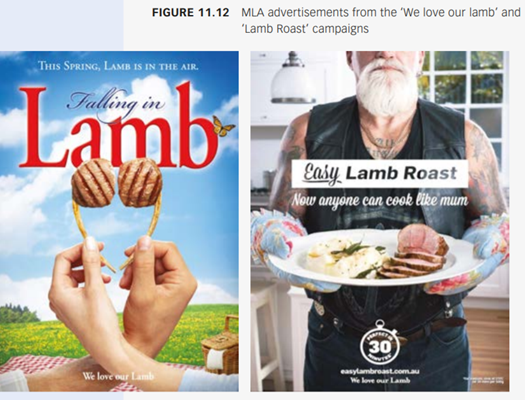
Because sustained demand was one of the objectives, MLA targeted a wide audience—which was perfectly demonstrated with the 2013 ad ’Now anyone can cook like mum’ depicted in Figure 11.12. The media schedule focused on mass media (including television) with a year-round presence, for maximum reach with continuity but with appreciation for seasonality—to create extra demand for lamb during the higher production period and to build the association between spring and lamb—as well as key entertaining dates. They particularly wanted to reach light buyers, because of the potential for sales growth with that group
Although each of the advertisements is unique, the style of all of MLA’s communications is consistent, using a tongue-in-cheek sense of humour. This makes the ads memorable and likeable.
MLA has used celebrity power to help sell lamb. The ‘Lambassador’—sports commentator and former AFL player Sam Kekovich—featured in lamb commercials from 2005 for roughly a decade and was central to the ‘We love our lamb’ campaign. More recently iconic cricket commentator Richie Benaud asked his mates over so he didn’t ‘lamb alone’. Sam Kekovich, Billie Birmingham and Ita Buttrose, as well as Australian historical icons including Captain Cook, stepped in and promoted lamb at an Australia Day BBQ at Richie’s place; see it at . Building on what has worked for the brand in the past, the MLA in 2017 demonstrated that it is possible to be inclusive of a broad audience while creating content that people want to watch and that captures attention— while making the product the hero; see it at
This history of (mostly) consistently great executions with evidence-based media planning has contributed to cementing a new image for lamb and building and refreshing mental availability for it. While the data to link these campaigns to sales directly is not available to the authors—single-source data is ideal here and is not available in Australia—it is promising to see the strong growth in lamb prices since the early 2000s (Dahl, Martin & Gray, 2014). Coupled with the success of marketing lamb meat for the international market, it has been a winning combination both for MLA and for the producers they work for.

1 Discuss the pros and cons of investing in a celebrity to endorse your brand versus creating a character that can take on this role—for example, the Energiser Bunny, the Michelin Man or Aleksandr Orlov, the anthropomorphic Russian meerkat founder of.

2 Discuss the bene­ts of remaining consistent with a campaign idea (e.g. over years or decades) and identify the pressures or reasons that might lead an advertiser to abandon a long-running campaign.

 
"Looking for a Similar Assignment? Get Expert Help at an Amazing Discount!"

solution

CASE STUDY

Keeping brand advertising consistent for decades: Priceless

BY KELLY VAUGHAN

People have a tendency to pay attention to information they are exposed to given their existing knowledge and memory networks. They are attracted to the familiar. In the advertising context, we nd people are more likely to notice and pay attention to ads for brands they already use, and less likely to notice ads for brands they do not use. The implication is that advertisers should aim to remind people about something they already know, refreshing the existing memories linked to the brand in order to prevent people forgetting about the brand.
What is really important is that advertisers make ads that are easily recognisable and linked to our brand, but that also include links to relevant cues that might later be triggered in purchase situations. Having consistent advertising campaigns over long periods of time helps to refresh the existing links in memory to a brand. Often campaigns are changed unnecessarily because marketers and agencies get tired of the same campaign, which is well before the consumer does. Switching the focus of every new campaign to something di­erent means you are making it harder for the ad to be recognisable to people, as it is not something they are familiar with. This may also mean the ad has to work harder to gain viewers’ attention (through astounding creativity—but this is really dicult). Successful brands are consistent with their advertising over long periods of time, as well as across all branded touch-points with consumers.
Take for example MasterCard’s ‘Priceless’ campaign, which originated in 1997 (Dan, 2014). It has been used since that time across a range of di­erent media platforms, and more recently using digital media. In 2015 ‘Priceless Surprises’ was launched around the Grammy Awards in America with fans of MasterCard, brand-ambassador, Justin Timberlake being offered free downloads via Twitter of his latest release (Fletcher, 2015).
MasterCard is a large successful brand that understands to stay big they must continue to advertise and keep things consistent to make it as easy as possible for people to link their advertising e­orts to their brand. They have kept the campaign fresh over these years by introducing new situations in which MasterCard can be used, thus limiting any concern about potential wearout. Situations where MasterCard

CASE STUDY Keeping brand advertising consistent for decades: Priceless BY KELLY VAUGHAN People have...

As advertisers, we need to not only ensure that our advertising efforts gain attention, but also include relevant brand memory associations. MasterCard has done this well by keeping the campaign consistent over a long period of time, but introducing new situations with each execution, which helps build the network of associations linked to the brand in memory. This builds and maintains MasterCard’s mental availability, making it easier for the brand to be noticed or come to mind in purchase situations.
The consistency of the ‘Priceless’ campaign for MasterCard has also meant that the creative ad style has become a distinctive asset for the brand. This means that if someone only saw part of the advertisement, featuring that distinctive asset, there is a better chance that it is correctly linked to MasterCard due to its consistent use. People have learnt to associate the brand name with the slogan and the ad-style. By continuing to use these elements, MasterCard is working with the existing memories in the minds of consumers, making it more likely to gain people’s attention and making the ad easier to process into memory.
Great advertising clearly looks like the brand it is advertising, and successful brands such as MasterCard do this very well. Commitment is required over long periods of time (ideally decades) to ensure consistency across campaigns. Advertising should be created with passive uninterested viewers in mind, so that even they can identify which brand the advert is for. Less than 20 per cent of television ads are both noticed and correctly branded, therefore having sucient branding in advertising is essential. Poorly branded executions run the risk of not only going unrecognised, building nothing in people’s heads, or worse, being misattributed to another brand, meaning your advertising is beneting the competition.

1. Your brand has a long-running campaign creative (like MasterCard’s ‘Priceless’) and your agency has pitched you a new idea. Their argument is the campaign is old and people are bored with seeing it. Would you agree it is time for a change? Why or why not?

2. It is important that any advertising can be attributed to the correct brand. How would you ensure the branding is clear in the advert? Is direct branding (i.e. showing and saying the brand name) the only way?

3. Is it appropriate to only show branding at the end of the advertisement? Do consumers often watch ads and wait for the brand to be revealed?

4. If you were managing a brand of toothpaste, what relevant brand associations do you think would be important to include in a campaign?

 
"Looking for a Similar Assignment? Get Expert Help at an Amazing Discount!"