solution

CASE STUDY

 Give it away—and increase profits?

BY DAG BENNETT

It used to be that downloading games onto a laptop or smartphone generally cost 99c or $1. At that price, thousands of people bought games, generating a modest revenue stream for the game designers. But these days, there are many free games and millions of people who download them.
You might think that giving something away is a silly or risky strategy. However, many game and application designers have found that when they charge up-front for a product, sales stay small, but if they give the game away as a free download, millions of people will download it without thinking twice about it. Once they start playing, the games get ‘sticky’, or even addictive, and people will then become willing to pay for extra features to ‘up’ their game (e.g. new characters, extra lives, power-ups or special boosters). Even if only a small percentage of the millions of players buy extra features, the games makers still find they can increase their revenues.
One company that appeared particularly successful at this pricing strategy is Zynga, which capitalised on FarmVille and its other Facebook games with an initial public offering that raised US$1 billion. FarmVille is free to play, but players can purchase ‘farm cash’ that can be used to make crops immediately ready for market. However, by 2015 Zynga was still losing money.
This strategy of giving something away, sometimes called ‘freemium’ pricing, presents customers with what they see as a great deal by allowing them to use a product as much as they like, and then decide to give a couple of dollars to the game developer. Once they pay, they also tend to play more. In addition, customers can then be exposed to new game features and other, again initially free, games.
The buying process can be made simple by including a virtual store inside a game. Flurry, a mobile software analytics ‑ firm, estimates that about 65 per cent of all revenue generated in the iPhone app store comes from free games that charge for extra goods or features. Apple makes it very easy for people to make purchases within apps by keeping credit cards on ‑ le. Google’s app store, Google Play, on the other hand, initially struggled to generate revenue despite around 50 billion app downloads by 2015 because making payments was more difficult. The bottom line seems to be that free games can hook buyers, but purchasing has to be easy in order to deliver revenues.
The applications of freemium pricing are not conined to games—other companies that use it are LinkedIn for networking, Dropbox for ‑le-sharing, Hulu for TV shows, and the B2B companies Box and Yammer. And yet, freemium pricing is not a guarantee of success in the marketplace. To be successful, a company has to offer something that the market wants in the ‑rst place. Then it must ‑gure out the features that customers are willing to pay for, and at what price levels.

1. If a company has a freemium strategy, but is attracting few new customers, what might this indicate?

2. If a company’s premium strategy attracts a lot of customers, but doesn’t generate much revenue from them, what do you think they might be doing wrong?

 
"Looking for a Similar Assignment? Get Expert Help at an Amazing Discount!"

solution

Case Study

Zara: Just getting started

BY KELLIE NEWSTEAD

As the rest of the Australian retailing economy was flailing in April 2011 after the global financial crisis, reporting lost consumer confidence and increasing online shopping, the Zara Sydney store was just gearing up to open its doors, on all three levels of the new 1830-square-metre Westfield store (Tadros, 2010).
And open they did, amid shopper mayhem. Customers queued for hours and were quick to swipe items before they could make it to the shelf. Some estimates quote 80 per cent (AU$1.2 million) worth of stock being sold on the first day’s opening in Sydney (Burns, 2011). A few months later, the Melbourne Bourke Street store opened, with hundreds of people lining up to get in.
So how do they do it? Zara has a unique business model that essentially boasts good quality, on-trend merchandise and aordable prices, resulting in staggering profits. Each year, the reported 200 designers on staput out around 20,000 items (Inditex, 2016). The global distribution centre in Spain moves around 2.5 million items per week, and nothing stays in the warehouse for longer than 72 hours at a time (Kottke, 2015).
Chief Communications O‑cer Jesus Echevarria is quoted as saying the strategy of the fast-fashion retailers is ‘the complete opposite’ to the traditional model. He says, ‘it’s a matter of customer feedback. We are pretty quick to react’ (Burns, 2011).
Zara puts the success down to using customer feedback to design their range. However, it is the business model that incorporates speed rather than unique innovation that sets Zara apart from the rest.
It is reported that Zara uses customer feedback and a daily sales analysis from all 1830 stores to compile manufacturing plans within 48 hours (Burns, 2011). These plans are then communicated to 1500 factories in Asia, Spain and Brazil—the garments are then delivered to stores within three weeks (Burns, 2011). This means that Zara stores can be replenished with small-batch fashion choices twice a week.
Zara stocks many different products:  apparel for men, women and kids, plus bags, accessories and shoes. While Zara has at times been criticised for copying major designers, they insist that it is the customer-driven focus that gives shape to the products that they design worldwide.
From humble beginnings in 1975, when the first Zara store opened in A Coruña, Spain, Zara now operates in 88 countries, with online shopping also available (Inditex, 2016). Retailers like Zara represent a new wave of retailing, bringing production even closer to customer demands.

1 What can competitors learn from Zara?

2 How is Zara succeeding if they don’t have a unique product to offer?

3 Where can Zara go from here?

 
"Looking for a Similar Assignment? Get Expert Help at an Amazing Discount!"
solution

CASE STUDY

 Kindle Fire: $199 looks like a bargain

BY DAG BENNETT

In December 2011, Amazon introduced the Kindle Fire at a price of US$199. The Fire had a seven-inch full colour touch screen, WiFi and a cloud-accelerated web browser with access to movies, games, apps, music and books. The Fire looked to be competitive with Apple’s iPad2, although the iPad2 had more functions, and sold at the time for US$499. How was it that Amazon could set a price that seemed so low?
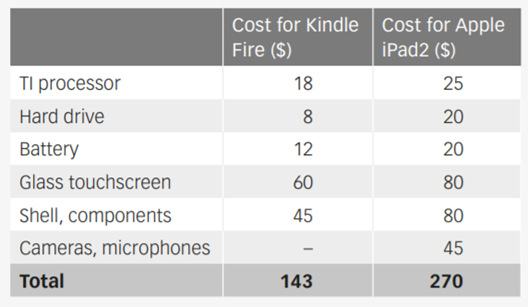
According to CNN Money (2011), the answer lay in what was included in the machine and what was left out. Comparing the Fire with the iPad2, you can see that the cost (based on industry-standard parts) of the core components for the Fire was substantially lower:

CASE STUDY Kindle Fire: $199 looks like a bargain BY DAG BENNETT In December 2011, Amazon introduced...

Across the board, lower componentry costs were achieved by installing a smaller hard drive, shifting memory functions to the cloud, and leaving out certain accessories altogether, such as cameras (the iPad2 had two of them). Even so, it is clear that the US$56 difference between cost and list price did not leave much to cover costs of assembly or other expenses, or for pro‑ ts, compared to the iPad’s US$229.
Apple routinely reports its sales ‑ gures, and claimed sales of around 11 million iPads in the last quarter of 2011. Amazon, on the other hand, was reticent about releasing its sales ‑ gures, but industry analysts estimated that 2 to 3 million Kindle Fires were bought in the holiday quarter, making it the bestselling competitor to the iPad.
Over the past three years, the competitive positions of the iPad and Kindle have remained much the same. The two brands are direct competitors, albeit with different operating systems, and they have much the same capabilities, yet the iPad continues to sell at a price 50 per cent or more higher than Kindle Fire.
In the ‑nal quarter of 2014, Apple sold 21.4  million iPads, or about 28 per cent market share, more than the next four tablet manufacturers combined. Only about 1.7 million Kindle Fires were sold by Amazon, putting it in ‑fth place with about 2.3 per cent market share.
One key difference between the Amazon and Apple strategies is that Amazon uses its e-book reader as a platform to sell other Amazon products, such as Amazon Prime and Kindle Books. In other words, the Kindle Fire can be sold at a lower price than its functionality might indicate because it gives Amazon a built-in means of capturing additional revenue from customers.

1. When a person buys a Kindle Fire, what are they really buying?

2. Can you think of other examples of ‘captive pricing’, where the ownership of a product leads to sales of supporting products or services?

3. How low do you think the price of the Kindle Fire can go?

4. Can you think of any competitive strategies that Apple might adopt in response to the Kindle Fire?

5. Do you feel the Amazon strategy has been effective?

 
"Looking for a Similar Assignment? Get Expert Help at an Amazing Discount!"
solution

CASE STUDY

Santa Lucia Wholefoods: Product development decisions

BY ELIZABETH GUNNER

Santa Lucia Wholefoods has been making dried pasta for over 15 years. They have always produced and sold just one product line:  a standard dried pasta distributed at supermarkets in a range of shapes. Now, the company directors have decided to invest in producing a second product line so that they can increase company pro‑ts. The product development team are considering two options for the new line: luxury pastas or gluten-free pastas.
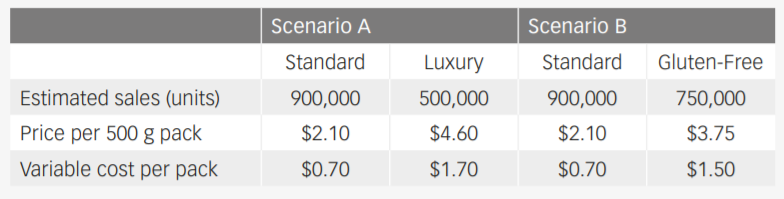
Currently, Santa Lucia Wholefoods sells 900,000 units of standard pasta annually at $2.10 per pack. It is predicted that if they produced a luxury brand they would sell 500,000 units of it each year (at $4.60 per pack); if they produced a gluten-free brand they would sell 750,000 units (at $3.75 per pack). The variable costs per unit are $0.70 for standard pasta, $1.70 for luxury pasta and $1.50 for gluten-free pasta. The annual ‑xed costs for the company are $1,500,000.

CASE STUDY Santa Lucia Wholefoods: Product development decisions BY ELIZABETH GUNNER Santa Lucia...

Questions

1 Divide the list below into ‑fixed and variable costs:

a. four for making the pasta

b. rental of the factory

c. wages for employees

d. eggs for making the pasta

e. machinery within the factory

f. packaging for the products

g. maintenance on machinery

h. advertising expenses.

2. Assuming that Santa Lucia Wholefoods achieves the predicted sales targets, what would the ‑fixed cost allocation per unit be if they produced standard pasta and luxury pasta (scenario A)? What would the ‑fixed cost allocation per unit be if they chose the gluten-free pasta instead of the luxury pasta (scenario B)? (Note: Fixed costs should be allocated evenly for all pasta units sold.)

3. Calculate the sales revenue for both products in both scenarios.

4. Which scenario would give a greater total pro‑t for the ‑firm?

5. For both scenarios, calculate the pro‑t margin for each product.

 
"Looking for a Similar Assignment? Get Expert Help at an Amazing Discount!"