CASE STUDY
Toothpaste marketing alarm
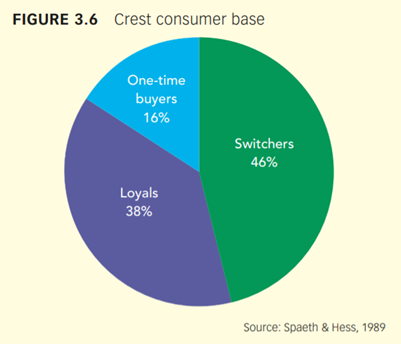
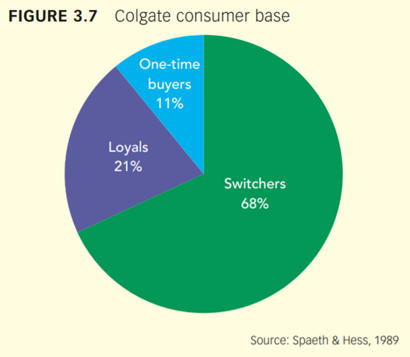
Imagine you are the Marketing Insights Director of Colgate Palmolive. You recall a time earlier in your career, when Margaret, the Senior Category Manager for Colgate toothpaste, stood at your oce door. She was clearly very concerned and was waving the report from the global market research supplier, which she had recently received. It showed that in the US, Procter & Gamble’s Crest brand had almost double the market share of Colgate (37 per cent compared to 19 per cent). In itself this was not a surprise, as this dierence had been the case for some years; the reason why Margaret was upset was the two graphs in the report (Figures 3.6 and 3.7) that showed the sales volume of each rival brand according to the recent repeat-buying behaviour of their consumers.
What was concerning Margaret was that the percentage of Colgate’s sales that came from loyal customers was almost half that of Crest’s sales from ‘loyals’, where ‘loyals’ were defined as people who bought the brand for the majority of their toothpaste purchasing during the analysis period used for the market research study. It seemed that Colgate’s sales came much more from ‘switchers’—people who bought Colgate at least once in the analysis period although most of their buying was of other brands.
Margaret needed an explanation of the apparent customer behaviour in the market. Her brand’s sales seemed very reliant upon people who were not very loyal to it. Was this what the research ‑nding meant? Why was the basis for Colgate’s sales apparently so much less healthy than Crest’s? Was the brand in serious trouble? Margaret had recently developed a marketing plan that had set some ambitious growth targets for the brand’s sales level over the next year.
After discussing the report, you and Margaret decided you needed more information and commissioned further market research of toothpaste buyers. This was to
break down the market share of each company’s brand to examine the switchers within both the Crest and Colgate customer bases. A questionnaire was devised and a survey conducted among similar people who had been surveyed for the earlier report. The ‑rst question in the survey asked about the attitudinal loyalty of purchasers of toothpaste to the major brands in the market. In the report from this second study was a diagram, shown here as Figure 3.8, which was the percentage of switchers who agreed with the statement ‘This is my preferred brand’.
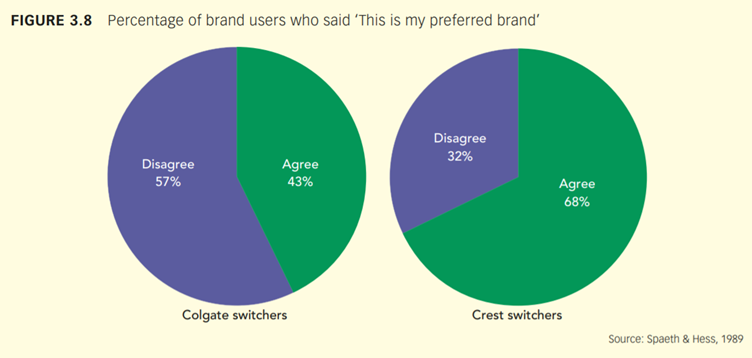
Figure 3.8 therefore showed that Crest’s switchers were substantially more likely to say that Crest was their preferred brand than was the case for Colgate’s switchers.
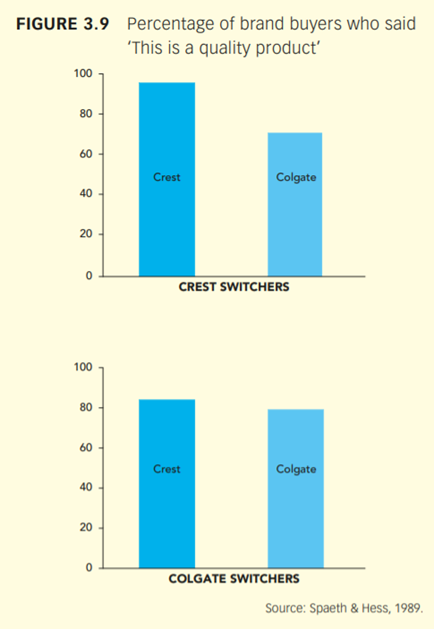
The survey’s second question asked customers about their perceptions of the quality of toothpaste brands, and Figure 3.9 shows the quality perceptions of the switchers in each brand’s customer base.
It could be seen that both Crest and Colgate buyers perceived both brands to be quality products—as they should, because these are both well-made products manufactured by large, experienced companies. However, it was observed that people who bought Crest, and who also often bought other brands, were slightly more likely to state that Crest was a quality brand than Colgate.
In its report on the second study to Colgate, the market research agency oered in its conclusion section some ‘brand insights’, notably that:
■Colgate’s sales volume comes mostly from nonloyal buyers
â– Colgate is 50 per cent more dependent on switchers than Crest
â– Colgate buyers are less loyal, both behaviourally and attitudinally
â– even Colgate buyers think Crest is a quality product
â– Colgate is a quality product but it has perception problems and lacks loyalty
â– Colgate seems to be attracting the wrong sort of buyer.
These insights were followed by some recommendations for action. These included that Colgate needed:
■more persuasive advertising that stressed Colgate’s quality
■advertising to be conducted comparing Crest unfavourably to Colgate in features and bene‑ts
â– media schedules that achieve high frequency of exposure of the advertisements to shift attitudes
■further research studies to identify the pro‑le of Colgate ‘loyals’ with the aim of attracting more people like them.
You and Margaret thanked the market research company for their work after they had made a presentation of their ‑ndings and recommendations, saying that you agreed with their analysis and recommendations. When discussing the ‑ndings afterwards, you and Margaret both agreed that the recommendations made sense in light of the apparent market circumstances. You felt that others in the marketing management community would agree with them, as the insights and proposed strategy appeared reasonable, and not unusual.
A week later, a marketing consultant happened to be visiting Colgate’s marketing department about another matter and was shown the reports on the toothpaste market research and asked his opinion on the conclusions and proposed actions. He was aware of the scienti‑c studies of buyer behaviour conducted by Andrew Ehrenberg and the need to interpret marketing metrics against known patterns in consumer behaviour.
He advised that you and Margaret were allowing yourselves to be unnecessarily alarmed by the market research ‑ndings. He said that Colgate’s loyalty metrics, both attitudinal and behavioural, were normal for a brand with half the market share of Crest. Indeed, he explained that all the other research findings were essentially just a result of the fact that Colgate has half the market share of Crest in this market—and hence fewer buyers, who also would buy less often in any period of time. The metrics in the reports, he said, did not show why Colgate was half the size; they were what they were because of Colgate’s size.
He stressed that there was nothing in this market research that suggested that the Colgate brand had any image or perception problem. The brand was not ‘weak’ or ‘unhealthy’—it was simply smaller than Crest, which had long been the case, and had long been known by management.