solution

The University of Pennsylvania basketball team will play both the University

of Kansas and Nowhere University this year on Penn’s campus. Kansas is a

nationally ranked team, while Nowhere is just plain terrible.

The athletic director traditionally prices each game separately. You

approach him and point out that two other pricing options exist. One possibility

is to offer a pure bundle, that is, a ticket package containing one Kansas

ticket and one Nowhere ticket. The second possibility is a mixed bundle. In this

situation, a pure bundle is offered but admissions to the games can also be sold

separately. It costs Penn a constant 5 per spectator to produce a game. It would

cost Penn 10 to produce a bundle of a Kansas game and a Nowhere game.

Three types of potential spectators exist (A, B, and C). There are an equal

number of types (for simplicity, assume one of each type). Their reservation

prices for each game are shown below:
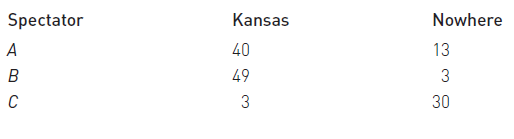
The University of Pennsylvania basketball team will play both the University of Kansas and Nowhere...

Penn’s policy is not to price discriminate. A spectator’s reservation price for a

bundle of the two games is the sum of their reservation prices for each game.

A spectator wants (at most) one admission to each game.

What’s your pricing advice to the athletic director (so that the director

maximizes Penn’s profit)? b. Given the current pricing policy of Penn, what’s your advice worth to the athletic director?


"Looking for a Similar Assignment? Get Expert Help at an Amazing Discount!"

solution

Bill Gates inherited intelligence, ambition, and a competitive spirit from his father, a successful Seattle attorney. After graduating from a private prep school in Seattle, he enrolled in Harvard but dropped out to pursue his passion—computer programming. Paul Allen, a friend from prep school, presented Gates with the idea of writing a version of the BASIC computer language for the Altair 8800, one of the first personal computers on the market. Driven by his competitive nature, Gates decided he wanted to be the first to develop a language to make the personal computer accessible for the general public. He and Allen established the Microsoft Corporation in 1975. Gates’s passion and skill were programming—he would work night and day to meet the extremely aggressive deadlines he set for himself and his company. Eventually Gates had to bring in other programmers; he focused on recent college graduates. “We decided that we wanted them to come with clear minds, not polluted by some other approach, to learn the way that we liked to develop software, and to put the kind of energy into it that we thought was key.” In the early days of Microsoft, Gates was in charge of product planning and programming while Allen was in charge of the business side. He motivated his programmers with the claim that whatever deadline was looming, no matter how tight, he could beat it personally if he had to. What eventually developed at Microsoft was a culture in which Gates was king. Everyone working under Gates was made to feel they were lesser programmers who couldn’t compete with his skill or drive, so they competed with each other. They worked long hours and tried their best to mirror Gates—his drive, his ambition, his skill. This internal competition motivated the programmers and made Microsoft one of the most successful companies in the computer industry, and one of the most profitable. The corporation has created a tremendous amount of wealth—many of its employees have become millionaires while working at Microsoft, including, of course, Bill Gates, currently one of the richest men in the world. During the 1990s Bill Gates’s net worth grew at an average rate of $34 million per day; that’s $200 million per week! Gates needed a castle for his kingdom, so he built a much-talked-about house on Lake Washington. The house lies mainly underground and looks like a set of separate buildings when viewed from above. The house was conceived as a showcase for Microsoft technology—it took $60 million, seven years of planning and construction, and three generations of computer hardware before it was finally finished. A feature of the house that reveals a lot about its owner is the house’s system of electronic badges. These badges let the house computers know where each resident and visitor is in the house. The purpose of the badges is to allow the computer to adjust the climate and music to match the preferences of people in the house as they move from room to room. What happens when more than one person is in a room? The computer defaults to Gates’s personal preferences. 1. Would you classify Bill Gates as a charismatic or transformational leader? Why? 2. Consider the followers and employees of Gates. What are some unique characteristics of Gates’s followers that might identify him as charismatic or transformational?


"Looking for a Similar Assignment? Get Expert Help at an Amazing Discount!"

solution

The Bergen Company and the Gutenberg Company are the only two firms

that produce and sell a particular kind of machinery. The demand curve for

their product is P = 580 – 3Q

where P is the price (in dollars) of the product, and Q is the total amount

demanded. The total cost function of the Bergen Company is

TCB = 410QB where TCB is its total cost (in dollars) and QB is its output. The total cost function

of the Gutenberg Company is TCG = 460QG

where TCG is its total cost (in dollars) and QG is its output.

a. If these two firms collude and they want to maximize their combined

profit, how much will the Bergen Company produce?

b. How much will the Gutenberg Company produce?

c. Will the Gutenberg Company agree to such an arrangement? Why or

why not?


"Looking for a Similar Assignment? Get Expert Help at an Amazing Discount!"

solution

The can industry is composed of two fi rms. Suppose that the demand curve

for cans is P = 100 – Q

where P is the price (in cents) of a can and Q is the quantity demanded (in

millions per month) of cans. Suppose the total cost function of each firm is

TC = 2 + 15q where TC is total cost (in tens of thousands of dollars) per month and q is the

quantity produced (in millions) per month by the firm.

a. What are the price and output if managers set price equal to marginal

cost? b. What are the profit-maximizing price and output if the managers collude

and act like a monopolist? c. Do the managers make a higher combined profit if they collude than

if they set price equal to marginal cost? If so, how much higher is their

combined profit?


"Looking for a Similar Assignment? Get Expert Help at an Amazing Discount!"