solution

Economic and Business cycles are a reality all businesses must face. Global, national, and regional economies all go through cycles of growth and shrinkage based on a wide range of factors. In Canada one of those economic cycle factors is the price of crude oil since Canada is a major oil exporter (solely to the USA). Then there are business cycles as individual businesses develop, mature, and decline, or as their markets grow, stabilize, and decline. It is a steady pattern of interacting cycles with complex interactions and few predictable outcomes.

Think in terms of systems theory, complexity, and logic to suggest how a business might plan for its future given these realities. What are the key indicators you would look for and how would you recommend adjusting your business to them? Could you develop a plan to prosper in a major economic downturn? Or develop a way to get out of an individual business or market down-cycle? If you are thinking in terms of a Canadian business, how might the proximity of the USA affect your thinking?

 
"Looking for a Similar Assignment? Get Expert Help at an Amazing Discount!"

solution

Pakistan Steel Mills, the largest industrial project in the country’s history, was established in the 1970s with technical assistance from the erstwhile Soviet Union. It produced long-rolled steel and heavy metal products and was the pride of the country for many years. It continued to operate in profit until 2008 – albeit at a reduced capacity. According to a recent press report, the Pakistan Steel Mills finally shut down for good on June 10, 2015.

A number of attempts were made by successive governments to somehow jump start this strategically vital national asset but to no avail. Prolonged litigation, allegations of corruption against PSM’s former top executives, bureaucratic delays, etc. all stymied various governments’ efforts to privatize the Pakistan Steel Mills.

Your assignment: Assume that you are a team member of an international management consulting firm tasked by the Government of Pakistan for formulating an overarching strategy for reviving the Pakistan Steel Mills and restoring it to its former glorious status.

Your team may recommend any/ all options – including privatization. Your team may also suggest strategic initiatives for effecting a successful turnaround of PSM while remaining in the public sector as was successfully accomplished in the case of Pakistan State Oil.
1. Start your submission by giving a brief historical narrative of how PSM gradually fell into this financial abyss. This introductory part should be in one brief paragraph not exceeding 200 words.

2. Using the PESTEL (or PESTELE) model and other macro and micro-environmental factors discussed in the online lectures, identify and discuss the local/international trends that had affected the working of Pakistan Steel Mills until its “demise” in 2015. Your submission should be in bullet format; the bullets must read as grammatically complete sentences.

3. Using the concepts taught in the ongoing online course, formulate a strategy/strategies for effecting a turnaround for this troubled organization. Be realistic, practical and to the point. You may consult – for reference purposes only – the EFE and IFE matrices, and CPM of PSM vis-a`-vis other competitors – both local and foreign. These may be available on the Internet; but please do NOT copy-paste anything verbatim. You may consult the Internet and obtain a format for writing a consultant’s report; there are many examples available. You may use paragraph format in this part with proper headings and topic sentences for each paragraph.

4. Lastly, present 10-15 cogent strategy recommendations that summarize the way forward for PSM. Again, your submission should be in bullet format; the bullets must read as grammatically complete sentences. Please ensure that your recommendations relate to strategy, and not tactical or operational matters.
Your entire report should be between 500-1000 words. Please do NOT exceed this limit.
Do NOT limit yourself merely to financial analyses; discuss all strategy related aspects in all organizational areas including policy making, operations, marketing, management, MIS


 
"Looking for a Similar Assignment? Get Expert Help at an Amazing Discount!"

solution

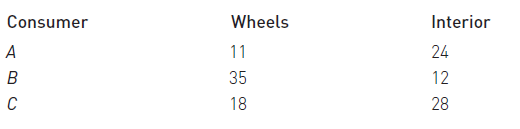
GeeM has a sporty wheel package and a luxury interior package that it is considering

offering to its auto buyers. GeeM has estimated that there are three

consumer types (A, B, and C—all of equal magnitude—for simplicity, consider

it one of each type). Consumers want (at most) one of each package. It costs

GeeM 5 to produce a sporty wheel package and 10 to produce a luxury interior

package. It will cost GeeM 15 to produce a bundle consisting of both packages.

The following are the consumer reservation prices for each package:

GeeM has a sporty wheel package and a luxury interior package that it is considering offering to its...

A consumer’s reservation price for a bundle consisting of sporty wheels and

a luxury interior is the sum of the individual component reservation prices.

GeeM does not price discriminate.

GeeM has solicited your help in pricing the wheel and interior package.

You know that they could sell the packages separately, as a pure bundle, or as

a mixed bundle. Of those three pricing strategies, which one would maximize GeeM’s

profit? What are the prices (what is the price) that you suggest? How much

better is the best pricing strategy than the second best pricing strategy?


"Looking for a Similar Assignment? Get Expert Help at an Amazing Discount!"

solution

Food for Life makes health foods for active, outdoor people. Their three basic

products are whey powder, a high protein strength bar, and a meal additive

that has the taste and consistency of sawdust. Research shows that consumers

fall into two types (A and B) and these are described in the table below by their

reservation prices for the products. Each consumer will demand no more than

one unit of any product at their reservation price. The consumers will value a

bundle of the products at the sum of the constituent reservation prices. Each

product costs $3 to produce. A bundle of all three products costs $9 to produce.

Food for Life does not price discriminate. There is an equal number of each consumer type (for simplicity, one of each type).

What pricing (profit-maximizing) strategy (among pricing separately,

pure bundling, and mixed bundling) would you recommend to Food for Life?

Why? Only bundles of all three products need to be considered.


"Looking for a Similar Assignment? Get Expert Help at an Amazing Discount!"