solution

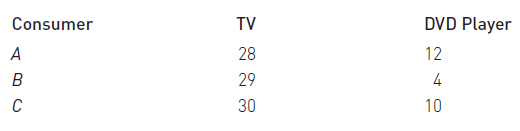
The reservation prices (in dollars) of three classes of demanders (classes A, B,

and C) for Ricky Parton’s (a Latin country-western singer) compact discs are

given in the table that follows:

The reservation prices (in dollars) of three classes of demanders (classes A, B, and C) for Ricky...

It costs $4 to produce and distribute each compact disc. The company can sell

each CD separately, can put them together as a boxed set (that is, as a pure

bundle), or can sell them in a mixed bundling format (offer the CDs both

separately and as a boxed set). Assume that each demander wants only one of

each of the CDs at the reservation price (or at any lower price) and that there

are an equal number of demanders in each class. For simplicity, assume that

the only costs are those mentioned here.

a. What pricing method would you advise Ricky’s company to use?

b. How much better (profitwise) is the best pricing method than the second

most profitable pricing method?


"Looking for a Similar Assignment? Get Expert Help at an Amazing Discount!"

solution

Redecorating and renovating have become a popular international pastime. In a world facing persistent terrorist alerts and lagging economies, more and more people are opting to stay home and make their homes safe havens. This phenomenon has contributed tremendously to the success of IKEA, the Swedish home furniture giant. In the past 10 years sales for IKEA have tripled, growing from over $4 billion in 1993 to over $12 billion in 2003. Much of IKEA’s success can be attributed to its founder, Ingvar Kamprad. Kamprad used graduation money to start IKEA in the small Swedish village where he was born. He started off selling belt buckles, pens, and watches—whatever residents in the small local village of Agunnaryd needed. Eventually Kamprad moved on to selling furniture. One day in 1952, while struggling to fit a large table in a small car, one of Kamprad’s employees came up with the idea that changed the furniture industry forever—he decided to remove the legs. IKEA’s flat-pack and self-assembly methodology was born, and it rocketed the company past the competition. “After that [table] followed a whole series of other self-assembled furniture, and by 1956 the concept was more or less systematized,” writes Kamprad. Kamprad is dedicated to maintaining the corporate culture he has helped define over the past 50 years. He is a simple man—his idea of a luxury vacation is riding his bike. He is fiercely cost-conscious and, even though his personal wealth has been estimated in the billions, he refuses to fly first class. He values human interaction above all, and, even though retired, he still visits IKEA stores regularly to keep tabs on what is going on where the business really happens. The culture at IKEA is a culture closely connected with Kamprad’s simple Swedish farm roots. It is a culture that strives “to create a better everyday for the many people.” IKEA supports this culture by • Hiring co-workers (IKEA prefers the word co-workers to employees) who are supportive and work well in teams. • Expecting co-workers to look for innovative, better ways of doing things in every aspect of their work. • Respecting c o-workers and their views. • Establishing mutual objectives and working tirelessly to realize them. • Making cost consciousness part of everything they do from improving processes for production to purchasing wisely to traveling costeffectively. • Avoiding complicated solutions—simplicity is a strong part of the IKEA culture. • Leading by example, so IKEA leaders are expected to pitch in when needed and create a good working environment. • Believing that a diverse workforce strengthens the company overall. The IKEA culture is one that resonates for many. The buildings are easy to identify—the giant blue and gold warehouses that resemble oversized Swedish flags are hard to miss. Millions of customers browse through the Klippan sofas and Palbo footstools (Nordic names are given to all IKEA products) in the stark, dimly lit warehouses. The surroundings may not be lavish and the service may be minimal, but customers keep going back not just for the bargains but to experience the IKEA culture as well. 1. Discuss the three input components of the Congruence Model as they apply to the success of IKEA. 2. Consider Schein’s four key organizational culture factors 6. What examples can you identify within the IKEA organization that contribute to the company’s strong corporate culture? 3. Based on the level of technological complexity and the degree of environmental uncertainty present at IKEA, what type of organizational structure would you expect?


"Looking for a Similar Assignment? Get Expert Help at an Amazing Discount!"

solution

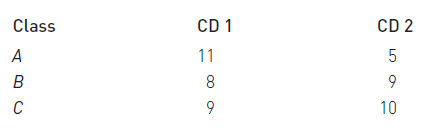
Bob and Ron’s Stereo sells televisions and DVD players. They have estimated

the demand for these items and have determined that there are three consumer

types (A, B, and C) of equal number (assume one for simplicity) that

have the following reservation prices for the two products. Bob and Ron’s cost

for a TV is 9 and for a DVD player is 9. It will cost Bob and Ron 18 to produce

a bundle of one TV and one DVD player.

Bob and Ron’s Stereo sells televisions and DVD players. They have estimated the demand for these...

Any consumer’s reservation price for a bundle of one TV and one DVD player

is the sum of their reservation prices for each item. Consumers will demand

(at most) one TV and one DVD player.

a. If Bob and Ron only consider pricing each item separately, pricing a pure

bundle, or pricing a mixed bundle as their pricing policy, what price(s)

would maximize their profit and what would be their profit?

b. If Bob and Ron were able to perfectly price discriminate (that is charge

different prices to different consumers, how much would their profit

increase over their optimal profit in part a?


"Looking for a Similar Assignment? Get Expert Help at an Amazing Discount!"
solution

w was the highest post in research and development other than the position of director of research and devels engineering position and four as a section chief. The latter promotion Morgan daimed that “the company doesn’t really care about its good people. We View, the present director, Harry James, does not want to allow his better people to Morgan also claimed she was told she “has a bright future with the company by both a can meet his own departmental goals without having to orient and train new experts up in the organization. He is more interested in keeping them in his own departments with employee development. Morgan recommended that steps be taken to remedy each of de She went on to criticize the company for using an appraisal form with no sections for dead and the former personnel director. Her performance appraisals have been uniformly excele ment opportunities, rewards for supervisors who successfully mentor subordinates, planning problems she identified. Among these steps were helping employees identify future developer of career paths and career ladders, greater efforts to help employees achieve work family We to identify future job opportunities, better communication of job opportunities, identification balance, childcare assistance, and telecommuting opportunities. Sweeney checked out the information Morgan had provided him and found it to be accurate. he has an immediate problem concerning high turnover of certain key employees. In addition, nearby competitor. Clearly, he has an even greater challenge than he had anticipated. He realines Moreover, he heard through the “grapevine” that she is in line for an excellent position with Sweeney also has a series of interconnected problems associated with career development. However, he is not quite sure what steps to take and in what order. STIONS 1. Describe the nature and causes of the problem faced by Harold Sweeney. 2. What additional questions should Sweeney ask or what additional information is needed before proceeding toward a solution to this problem? Why? 3. What are the individual and organizational benefits of a formalized career development system? 4. If Sweeney decides to develop a formalized career development system at Electronic Applications, what components or types of services should be offered? Why? 5. Should the career development activities be integrated with other human resource management activities? If yes, which ones? Why? 6. What criteria should Sweeney consider to evaluate good candidates for promotion? What criteria could be used to evaluate the performance of supervisors in development of their subordinates? solado Wood CASE 51 Career Development Career Development at Electronic Applications Electronic Applications Corporation is a major producer of silicon chips for the computer industry. It is located southeast of San Francisco in an area of high technology firms. Since its founding in 1972, the company has grown rapidly in terms of sales and profits, thus enhancing its stock price many times over. Human resource policies, however, have tended to lag behind company growth. Emphasis has been on reactive policies to meet the regulatory resources have not been a high priority. requirements of external stakeholders such as the federal government. In short, human Recently, Harold Sweeney has been hired as director of human resources for the company. Sweeney had previously served as assistant personnel director for a large “blue- chip” corporation in southern California. He accepted his present position not only because of bringing this company from a 1970s human resources mentality to one more compatible with an increase in pay and the realities of the 2000s.” responsibility, but also because of what he termed “the challenge of Sweeney has been on the job for four months and has been assessing the situation to the high turnover among electrical engineers who work in research and development and are determine the more significant human resource problems. One problem seems to have been the core of the research function. Prior to the 2008–2010 financial crisis, the turnover rate averaged about 30 percent per year over the past three years. As a result of the recent financial crisis, however, unemployment in Silicon Valley has increased to 9.7 percent . Most technology companies are not hiring at all or are only hiring individuals on a highly selective basis. The result is that most employees have decided to stay put in the short term, but will be looking to take advantage of more attractive opportunities elsewhere when and if the economy improves. Sweeney was aware of these intentions and wanted to take steps now to minimize future employee turnover. In assessing the cause of the problem, Sweeney checked area wage surveys and found Electronic Applications paid 5 to 8 percent above the market for various categories of electrical engineers. Since the company did not have a formal exit interview system, he could not check out other possible explanations through that mechanism. However , through informal conversations with a large number of individuals, including the engineers them- selves , he learned that many of the engineers felt “dead-ended” in the technical aspects of engineering. In particular, the research and development department had lost some of the younger engineers who had been considered to be on the “fast track.” Most had gone to competitors in the local area. One particular research and development employee who impressed Sweeney was Helen Morgan. Morgan is 29 years old, has a BS degree in Electrical Engineering from California Institute of Technology, and is studying for her MBA at the University of Santa Clara at night. Helen had been employed for seven years at Electronic Applications, three in an entry-level 157
 
"Looking for a Similar Assignment? Get Expert Help at an Amazing Discount!"