solution

Electric companies typically have 5–10 different rate schedules for their main

customer groups. The average price charged to large industrial users may

differ substantially from that charged to residences. Moreover, many consumers

pay a price for electricity based on the time of day they use it. For

example, the prices charged by Consolidated Edison, a large New York electric

utility, and Pacific Gas and Electric, a major California electric utility, are as

follows:
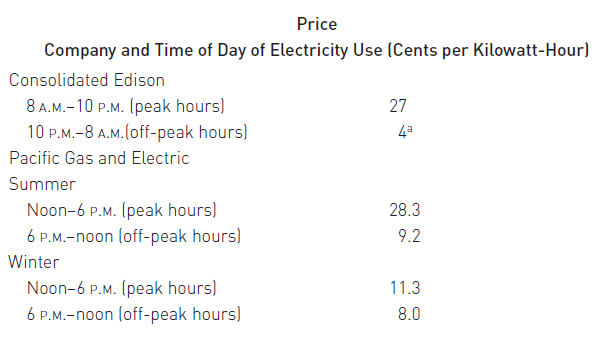
Electric companies typically have 5–10 different rate schedules for their main customer groups. The...

Electric utilities use their cheapest generators continuously and start up their

more costly ones as demand goes up. Consequently, at 3 a.m., a utility might

meet its requirements from a hydroelectric dam that produces electricity for

$0.02 per kilowatt-hour. However, on a hot day in August, when air conditioners

are running full blast, demand would be so great that the utility would

be forced to use its most costly generators—perhaps an oil-fi red plant where

electricity costs $0.07 per kilowatt-hour.

a. Does price discrimination occur in the market for electricity?

b. Why have some state regulatory commissions, including the Public

Service Commission of New York, ordered that time-of-day rates be

phased in for residential consumers?

c. In many areas, both residential and industrial consumers tend to pay a

lower price per kilowatt-hour if they use more rather than less electricity.

Is this price discrimination? If so, what kind of price discrimination is it?

d. Explain why price discrimination is used by managers of electric companies.


"Looking for a Similar Assignment? Get Expert Help at an Amazing Discount!"

solution

In the town of Oz, there are two types of tennis players: wizards and imps.

Wizards and imps do not socialize, so it would be impossible to start a tennis

club that both types would join. Imps have access to credit but a weak demand

for tennis as follows. PI = 30 – QI

where QI refers to the number of games they would play if the price of a game

were PI. Because of their access to credit, they would be willing to pay an upfront

fee to join the club. Wizards live from paycheck to paycheck and would be willing to pay for

each tennis game as they go along. Their demand is

PW = 40 – QW where QW refers to the number of games they would play if the price of a game

were PW. There are an equal number of wizards and imps (for simplicity, assume

one of each). The marginal cost of one game of tennis is a constant 2.

You can design your tennis facility to attract either wizards or imps (but

not both). Which clientele would you like to attract and what would be your

profit per “person”?


"Looking for a Similar Assignment? Get Expert Help at an Amazing Discount!"

solution

The managers of Roosevelt’s (a local yet upscale bar) are considering charging

an admission fee on Thursday nights. They contemplate how to charge.

Should they Option 1. Use just a beverage charge per beverage ordered or

Option 2. Use an admission charge (a fee to enter the establishment) and

a beverage charge per beverage ordered? There are two types of people who frequent Roosevelt’s: Over 21 Students (S) and Over 21 Student Wannabees (W). Each Student has a demand for beverages of P = 8 – QS where QS is the quantity of beverages demanded if the price of a beverage is P. Each Wannabee has a demand for beverages of P = 8 – 2QW

where QW is the quantity of beverages demanded if the price of a beverage is P.

The marginal cost of serving a beverage is a constant $2.

For simplicity, assume there is one demander of each type. Roosevelt’s

must (by law) charge all customers the same admission charge and the same

per beverage charge. Beverages do not have to be sold in integer amounts and

prices do not have to be in integer amounts.

a. Under option 1, what is the profit maximizing price per beverage?

b. Under option 2, what is the profit maximizing two-part tariff?

c. What is Roosevelt’s profit under Roosevelt’s best choice?


"Looking for a Similar Assignment? Get Expert Help at an Amazing Discount!"

solution

The demand for a strong demander for a round of golf is PS = 6 – QS

where QS is the number of rounds demanded by a strong demander when the

price of a round of golf is PS. The demand for a weak demander for a round of golf is

PW = 4 – QW where QW is the number of rounds demanded by a weak demander when the

price of a round of golf is PW. The cost of providing an additional round of golf to either type of golfer is a constant 2. There is one golfer of each type. The club has decided that the best pricing policy is a two-part tariff. However, it’s your job to tell the club the optimal entry fee and the optimal use fee to maximize the club’s profit. The club cannot price discriminate on either the

use or the entry fee. The club’s fixed cost is 1. What are the club’s optimal use fee and the optimal entry fee?


"Looking for a Similar Assignment? Get Expert Help at an Amazing Discount!"