solution

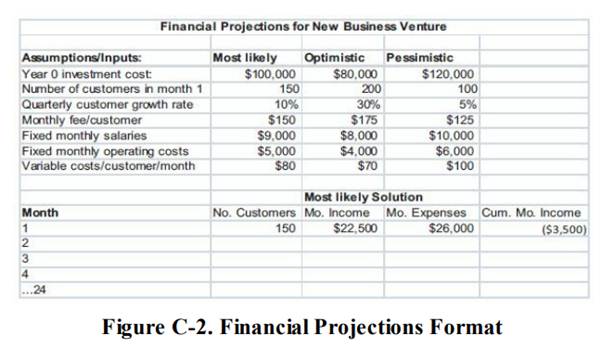
An important part of starting any business is preparing financial projections. Although you will prepare a more detailed financial analysis when you create your business plan, you still want to do rough projections at this stage. Prepare a spreadsheet that can be used to determine the profit potential of starting this business. Include inputs for the initial investment cost, number of customers in the first month, customer growth rate/quarter, average monthly fee per customer, fixed and variable monthly operating costs, and variable costs per customer. Use the most likely, optimistic, and pessimistic inputs as shown in Figure C-2 to generate results for all three scenarios. For each month (Month 1-24), calculate your revenues (number of customers that month X monthly fee/customer) and expenses (fixed monthly salaries plus fixed monthly operative costs plus variable costs/customer/month X number of customers that month). Then determine the cumulative income each month. For example, the cumulative income in Month 1 is the Monthly Revenues – Monthly Expenses for Month 1. The cumulative income for Month 2 is the Monthly Revenues – Monthly Expenses for Month 2 plus the Cumulative Income for Month 1. The first month for the most likely scenario is filled in for you to check your formulas. Will you be able to recoup your start-up costs within two years in each scenario? If so, in what month? There is no template for this example, but you can use the format in Figure C-2. Print out a sheet with results for each scenario, clearly labeling if/when you recoup your investment.
 
"Looking for a Similar Assignment? Get Expert Help at an Amazing Discount!"

solution

Develop a requirements traceability matrix and a scope statement for the project. Use the templates provided on the companion Web site, and review the samples in the text. Remember that the main project goals are to prepare a business plan, get financial backing, handle legal issues, develop marketing materials, find a rental space for the music academy, purchase/develop curriculum, and hire staff so you can open for business by one year from now. Be as specific as possible in describing product characteristics and requirements, as well as key deliverables. For example, assume that you need to rent a space for your business that is in a desirable part of town near other businesses and schools, has enough room for a reception area, technology lab with five computers, two larger band rooms that have soundproofing or can be sound proofed, and five small rooms for private lessons.

 
"Looking for a Similar Assignment? Get Expert Help at an Amazing Discount!"

solution

During recessions and economic hard times, many people—particularly those

who have difficulty getting bank loans—turn to pawnshops to raise cash. But

even during boom years, pawnshops can be profitable. Because the collateral

that customers put up (such as jewelry, guns, or electric guitars) is generally

worth at least double what is lent, it generally can be sold at a profit. And

because usury laws allow higher interest ceilings for pawnshops than for other

lending institutions, pawnshops often charge spectacularly high rates of inter-est. For example, Florida’s pawnshops charge interest rates of 20% or more per month. According to Steven Kent, an analyst at Goldman, Sachs, pawnshops make 20% gross profit on defaulted loans and 205% interest on loans repaid. a. In 2012 there were about 15,000 pawnshops in the United States. This

was much higher than in 2007, when the number was about 12,000. Why

did the number increase? b. In a particular small city, do the pawnshops constitute a perfectly competitive industry? If not, what is the market structure of the industry?

c. Are there considerable barriers to entry in the pawnshop industry? (Note:

A pawnshop can be opened for less than $250,000, but a number of states

have tightened licensing requirements for pawnshops.)


"Looking for a Similar Assignment? Get Expert Help at an Amazing Discount!"

solution

The demand for diamonds is given by

PZ = 980 – 2QZ where QZ is the number of diamonds demanded if the price is PZ per diamond.

The total cost (TCZ) of the De Beers Company (a monopolist) is

given by TCZ = 100 + 50QZ + 0.5Q 2

Z where QZ is the number of diamonds produced and put on the market by the

De Beers Company. Suppose the government could force De Beers to behave

as if it were a perfect competitor—that is, via regulation, force the fi rm to price

diamonds at marginal cost.

a. What is social welfare when De Beers acts as a single-price monopolist?

b. What is social welfare when De Beers acts as a perfect competitor?

c. How much does social welfare increase when De Beers moves from

monopoly to competition?


"Looking for a Similar Assignment? Get Expert Help at an Amazing Discount!"