CASEÂ STUDY
Social marketing and the kerbside bin
South Australia is a leader in embracing environmental initiatives. It was the Ârst state to introduce container deposit legislation (which provides a refund on drink containers to encouraging recycling); the Ârst to ban single-use plastic bags from retail outlets (thereby reducing visible plastic litter and the volumes going to landÂll); and the Ârst to declare it will become a Zero Carbon City (announced in 2015). South Australia was also ahead in standardising the kerbside household bin system across its 64 council areas. This system is made up of three bins provided to each household: a red bin for landÂll waste, a green bin for organics (including food scraps), and a yellow bin for recyclables. However, in order to realise the environmental beneÂts of such a bin system, householders are required to do correct separation and preparation of the items being disposed of, or else the collection trucks become contaminated and the truckload is unable to be processed. Zero Waste SA was the state government agency charged with managing the process of bin standardisation and householder education. With only a modest budget, the agency needed to develop a social marketing campaign to educate householders about correct bin usage and to evaluate the success of its e‑orts. Until this time, most households had not had a green organics bin as part of their waste disposal system and were typically disposing of kitchen scraps in the landÂll bin, or home composting. Additionally, there were many things that were put in the landfill bin—such as paper—that could actually be recycled and some that were going in the recycling bin (e.g. clothes) that were not suitable. Changes in technology produced even more new options, with soft plastics now able to be recycled and their collection being o‑ered through some supermarkets. The social marketing campaign aimed to educate householders about what could and could not go in each bin, how best to prepare materials before disposal—for example, removing lids from bottles before placing them in the recycling bin, rinsing containers to remove food or drink residue—and the importance of avoiding contamination.

The social marketing campaign that Zero Waste SA created featured radio and print media messages, as well as social media through local council and Zero Waste websites. In addition, banners, bin stickers (to achieve physical availability close to the point where the behaviour occurs), a smart phone app, and direct mail were used to reach householders and inform them of the changes and the best way to use the bin system. The campaign had the aim of maximising reach and cutthrough to householders, hence it used mass media as the primary communication platform with additional channel choices to add reach.
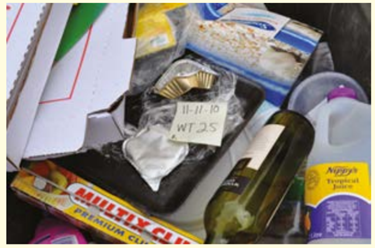
Multiple simple messages that were used around correct preparation and disposal of materials included:
■‘food scraps can go in the organics bin’
■‘clothing should not go in the recycling bin’
■‘don’t bundle up papers with string’
■‘no batteries in any bin’.
These messages were delivered consistently and repeatedly across these platforms, recognising that ingrained behaviours and passive viewing of messages will take repetitions to reach and cut-through to the audience.
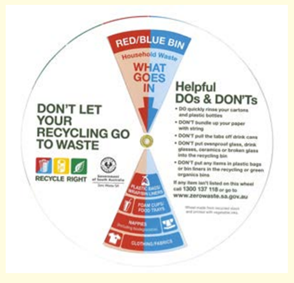
Evaluation was undertaken, which included measuring disposal behaviour prior to the campaign so that campaign effectiveness and behaviour change could be detected. The research included 1500 phone interviews and more than 600 observations where bins were audited to identify actual versus claimed bin practices and incorrect disposal incidence. The fiÂndings were used to move away from the focus on informational bin stickers—which had low instances of being used— and information sheets— which tended to be ignored— to mass print media and simple catchy print ads such as ‘if it doesn’t grow, it doesn’t go’, for the green organics bin. The main behaviours responsible for the observed contamination—as identiÂed in the audits— were used as the key campaign messages. The evaluation used observation of actual behaviours as a core component, as claimed behaviours are known to be inaccurate in such a context as people want to be seen to be ‘doing the right thing’.
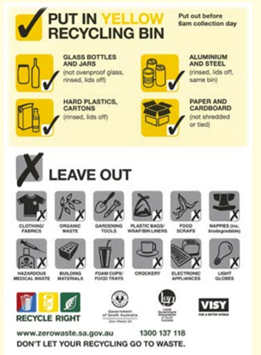
At the end of the campaign, the social marketing materials were made available to local councils so that they could continue to communicate with their residents and further reduce contamination and encourage the best use of the kerbside bin system.
This case study illustrates how social marketing can be applied to support a sign cant infrastructure change at a population-wide level. It shows how evaluation, built in from the start, provides valuable feedback to improve and reÂne the social marketing e‑orts. It also demonstrates that for social marketing to be effective it needs to adopt the same principles and tools as for-profit marketing. The focus for the marketing is on maximising physical and mental availability. In this case, placing the messages close to the time and place where the behaviour is to occur encourages behaviour change and builds knowledge.
1. This social marketing campaign is targeting behaviours that tend to be under reported (incorrect disposal and contamination of bins) by the individuals doing them. What other behaviours can you think of where similar challenges are faced? What challenges does this then pose for the success of a campaign?
2. Think about the evaluation aspect of this social marketing campaign. What would be the particular challenges involved in collecting the observational data and the interview data? What other methods could have been used? What quality of data would they have delivered in comparison to phone interviews and observation?
3. What other household behaviours can you think of that are also highly habitual and private yet require modiÂcation as technology and infrastructure change? What lessons can be learnt from the case of the kerbside bin system?







