solution
Case Study
Dilmah Ceylon Tea: Market development in Australia
BY RODNEY ARAMBEWELA, DEAKIN UNIVERSITY
Background
Dilmah Pure Ceylon Tea is a popular brand in the Australian tea market. The brand was Ârst introduced in 1984, at a time when the Australian market was dominated by multinational and major national brands such as Lipton, Bushells, Lanchoo, Tetleys, Harris and Twinings, and the barriers to new entry were very high. Sri Lanka was formerly called ‘Ceylon’—the country’s name was changed to Sri Lanka in 1972 when it became a republic—and tea from Sri Lanka has continued to be called ‘Ceylon tea’ to leverage the high consumer awareness of the quality of the tea. Ceylon tea exports from Sri Lanka to Australia were at their peak in the 1960s and 1970s, accounting for nearly 70 per cent of all tea imports. However, the Ceylon tea market share started to decline in the early 1980s, both in terms of volume and value, and an overhaul of the Ceylon tea marketing strategy was considered necessary to arrest this decline.

Following extensive marketing research and market analysis, a new strategy was developed to consolidate all marketing and promotional e‑orts on pre-packed pure Ceylon teas imported directly from Sri Lanka. This was to give a clear identity for Ceylon tea as single-country origin tea compared to other teas, which were of mixed origins. The outcome was the launch of Dilmah Pure Ceylon Tea in Australia—a logical undertaking to revitalise the Ceylon tea market position in Australia.
Australian tea market
Australia is among the largest tea-consuming countries in the world, with a per capita consumption of around 0.55 kilograms per year. Tea consumption was much higher in the 1960s, 1970s and 1980s: demographic and lifestyle changes over the years have had a major impact on tea consumption habits and consumer preferences continue to change. The greatest threat to tea came from co‑ee and carbonated beverages, as consumers looked for variety and convenience. The advent of teabags, green tea and herbal tea products was a direct result of the trends towards convenience and healthy lifestyles, which have had a major impact on the marketing of tea in Australia.
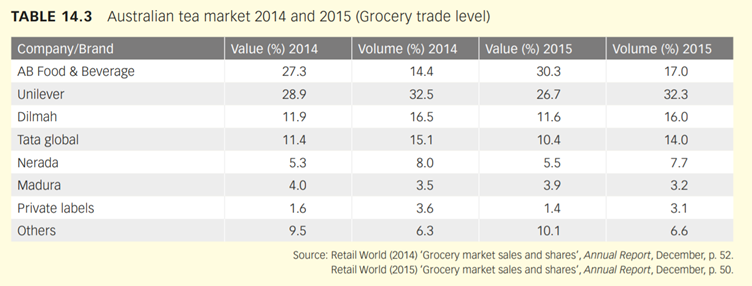
As Table 14.3 indicates, the Australian tea market is currently dominated by two large multinational companies—Unilever and AB Food and Beverage (a subsidiary of Europe’s largest food marketing companies, which also markets Twinings tea in Australia)—with a combined share of 57 per cent of the market in 2015 in terms of value, followed by numerous products and labels competing with each other for the remaining 43 per cent share, indicating a fragmented market. In 2015, the grocery value of tea was estimated at AU$314 million, while the total volume stood at 10,421 tonnes. The value of the market decreased by 1.1 per cent, while the volume decreased by 2.7 per cent. Despite the competition from multinational companies, Dilmah was able to carve out nearly a 12 per cent share of the market in terms of value and 16 per cent in terms of volume during 2015.
Market development strategy of Dilmah tea
The Dilmah brand was fiÂrst introduced in 1984, when the Australian market was dominated by multinational and major national brands such as Lipton, Bushells, Lanchoo, Tetleys, Harris and Twinings, and the barriers to new entry were very high.
Until the late 1990s, most of the teas consumed in Australia were packed locally by major packers such as Lipton and Bushells, although a small quantity of prepacked teas were still imported from Sri Lanka, India and other tea-producing countries. The packers imported tea in bulk from different sources for blending and packing under their own brand names. Some of these brands were identiÂed with the country of origin, such as Sri Lanka (Ceylon). Although Ceylon tea had a major share of the Australian market in the 1960s and 1970s, with packers using more Ceylon tea in their blends, price competition from new sources of origin such as Indonesia, Papua New Guinea and East Africa drastically a‑ected the preeminent position held by Ceylon tea in the market. Moreover, the growing teabag market called for a quick infusion tea, which could be produced through a di‑erent process of manufacture called the ‘cut, tear and curl (CTC)’ method. At this stage, all Sri Lankan tea manufacturing was based on the ‘orthodox’ or traditional method, which focused on the flavour and aroma of tea, while the new sources of origin specialised in CTC teas destined mainly for teabag production. As the Ceylon tea content in the blends and products of major packers declined, the share of Ceylon origin tea in the market dropped to the very low percentage of 8 per cent in 1983, compared to its 70 per cent share in the 1960s and 1970s. This was a major blow to the Sri Lankan tea market in Australia and a complete overhaul of the tea marketing strategy for the Ceylon tea brand was therefore necessary.
Successful marketing strategies begin with identification of an attractive market opportunity. It is also about matching market opportunities to the organisation’s resources and its objectives. Ceylon tea products were not new to the Australian market, but the challenge was to identify and develop new markets for Ceylon tea given the changes in the marketing environment. Another key challenge to the Ceylon tea concept was repositioning its image as a quality product, but this was hampered by the absence of any distinctive brand name that could be directly identiÂed with the country of origin. The marketing research indicated that the country of origin e‑ects on Ceylon tea products (typically communicated by the phrase ‘Pure Ceylon tea packed in Sri Lanka’), had a signiÂcant influence on the quality perception of the product among Australian consumers. Sri Lanka was considered one of the major tea-producing countries in the world, with a long history and expertise in tea production. While the consumer perception of the quality of Ceylon tea was widespread, the market research also indicated that Australian consumers had little or no access to pure Ceylon tea products because of the declining Ceylon tea content in products marketed by major packers. This was a major opportunity for Sri Lanka to capitalise on in its future strategic planning to develop brands of its own. So it was not only a case of a pure market development exercise but also of developing a credible identity for Ceylon tea to support market development strategies. There were a number of motivating factors that favoured the entry of a Ceylon tea brand packed in Sri Lanka to be marketed in Australia:
1. The cost advantages that Sri Lanka could achieve because of its low cost of production and packaging at the source.
2. Sharing the beneÂts of the proÂt margins available in the distribution chain.
3. The absence of any import duties or taxes for tea in Australia. All tea imports to Australia from any country of origin were exempt from import duties or taxes.
The Sri Lanka Tea Promotion Bureau (a Sri Lankan government entity) in Melbourne, Australia, initiated the new market development e‑orts with the support of the Sri Lanka Export Development Board (an export promotion agency funded by the government of Sri Lanka) and one of the major Ceylon tea exporters, Merrill J Fernando & Co., to introduce a Sri Lankan owned brand of tea packed in Sri Lanka. The Sri Lanka Tea Promotion Bureau commissioned a number of marketing research studies supported by consumer focus groups, surveys and product sampling to evaluate the market potential for a new Sri Lankan brand of tea followed by rigorous business analysis. This resulted in the development of marketing and communication mix strategies including branding, packaging, advertising and promotion. Freshness and quality were the key attributes that were promoted to di‑erentiate Dilmah from other tea products in the market. The price positioning was between the mainstream retail brands such as Lipton and the imported high-priced speciality teas such as Twinings to reflect its value proposition.
Dilmah was launched as a teabag product initially, but the product range expanded on a progressive basis to cater to di‑erent segments of the market. Dilmah currently markets a wide range of tea products, ranging from gourmet black tea, original gardens teas (single origin tea), green tea, deca‑einated tea, real white tea, organic tea, and flavoured tea to a variety of herbal infusions (Dilmah Australia, 2011). It has been responsible for rejuvenating the image of Ceylon tea, as well as rebuilding the trust and conÂdence of consumers and the tea trade that the ‘pure Ceylon tea’ concept is marketable.
1. Based on information in the case study, briey describe the tea-marketing environment in Australia in the early 1980s.
2. What are the key factors that prompted the introduction of a Sri Lankan owned tea brand into the Australian market?
3. Describe the process followed by Sri Lanka to introduce Dilmah Ceylon Tea to Australia.
4. Do you think the country of origin has had an impact on the success of Dilmah Ceylon tea in Australia?
5. Visit the Dilmah Ceylon tea website and comment on what future strategies the company should consider in order to sustain its market position in Australia.
"Looking for a Similar Assignment? Get Expert Help at an Amazing Discount!"