solution

The Kramer Corporation’s marketing manager calculates a regression, where

the quantity demanded of the firm’s product (designated as “C1”) is the dependent

variable and the price of the product (designated as “C2”) and consumers’

disposable income (designated as “C3”) are independent variables. The

Minitab printout for this regression follows
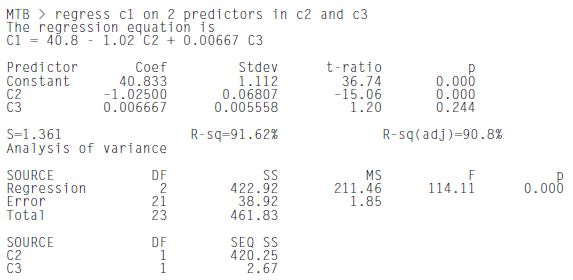
The Kramer Corporation’s marketing manager calculates a regression, where the quantity demanded of...

What is the intercept of the regression?

b. What is the estimated regression coefficient of the product’s price?

c. What is the estimated regression coefficient of disposable income?

d. What is the multiple coefficient of determination?

e. What is the standard error of estimate?

f. What is the probability that the observed value of the F statistic could

arise by chance, given that neither of the independent variables has any

effect on the dependent variable? g. What is the probability, if the true value of the regression coefficient of price is zero, that the t statistic is as large (in absolute terms) as we

observe? h. What is the probability, if the true value of the regression coefficient

of disposable income is zero, that the t statistic is as large (in absolute terms) as we observe? i. Describe briefly what this regression means.


"Looking for a Similar Assignment? Get Expert Help at an Amazing Discount!"

solution

Steve once worked as a regional sales director for a large health insurance company called Blue Star Health. Blue Star Health was once quite successful but had become complacent over the past five years. Competitors gained market share using aggressive marketing and sales tactics, and Blue Star was selling antiquated products and using inefficient processes for settling claims. With falling revenues and margins, Blue Star became an acquisition target and was bought by Anthum, a Fortune 100 company. At the conclusion of the deal Anthum brought in an injection of cash, a reputation for operational excellence, and a new vice president of sales, Jim Blaylock. The CEO of Anthum described Jim as bright, experienced, successful, and “more energetic than the Energizer Bunny.” Jim had joined the corporation immediately after college; because of his “potential” the company sent him to law school and rapidly promoted him into increasingly responsible positions. Senior management had tremendous confidence in Jim’s leadership abilities and appointed him as the vice president of sales in Blue Star Health, even though he had no previous sales experience. Steve was initially impressed with Jim’s freshness and energy; he was constantly touting “Midwestern values” and the “work ethic of the Midwest.” However, the sales management team soon became disenchanted with his views: Steve and his sales team were working 70 to 80 hours a week and becoming exhausted and frazzled. Moreover, Jim’s interactions with internal and external clients were lessons in poor human relations. He seemed to seek confrontations, and as time passed, his behavior became steadily more extreme. Jim harangued people, ignored appointments and made no excuses for missing them, made promises he never kept, called sales directors at 6:00 a.m. with insignificant questions, and abused brokers. Those who questioned Jim’s leadership were summarily dismissed. One day Jim asked Steve to arrange a meeting with a broker at 9:00 p.m. The broker was from a large benefit house and was older, and the meeting time was late. However, he was a longtime personal friend of Steve’s and as a courtesy agreed to the meeting. Jim did not show up for the appointment and would not answer Steve’s calls to his cell phone. After an hour, Steve and the broker went home. When Steve asked Jim why he missed the appointment, he said he was drinking with a friend and did not think the meeting with the broker was important. Jim refused to apologize to the broker and was surprised when business with the broker’s organization came to an end. Jim loved working on high-visibility projects and landed an opportunity to convert the membership of another acquired company to Anthum. This was an important project for Anthum, and shortly thereafter Jim set up an elaborate “war room” in which all sales planning and ac would take place. He asked Steve to lead the conversion project, repeatedly announcing that the acquisition was to garner new contracts and to bring quality employees into the organization. At this point Steve had over 70 direct reports in five different locations across the state and some aggressive sales targets. It would be impossible for Steve to hit his revenue numbers and run the conversion project. But Jim cut Steve no slack, and the computer system intended to convert the contracts did not work. Jim spent no time with any of the newly acquired sales team members, and as a result they showed no interest in working for Anthum. Yet Jim made grandiose statements about the quality of the sales force at the acquired company, which implied the current sales employees were unsatisfactory and fostered a sense of mistrust in both sales organizations. Because of Jim’s shoddy treatment, the long hours, and poor sales and invoicing processes, the morale of the sales team began to plummet. Tantrums and tears occurred frequently, and Steve spent a lot of time smoothing feathers and telling team members that things would get better over time. But there was only so much Steve could do, and as team members began to quit, Jim blamed Steve for the decline in department morale. As the situation continued to deteriorate, Steve requested that Jim meet with the remaining staff to talk about their frustrations with Anthum. Jim opted to set up an all-employee breakfast at a local restaurant to address their concerns. The night before the meeting a major snowstorm hit the city, and the streets were covered with a foot of snow. Some employees had to drive 40 miles to attend the meeting, but everyone made it to the restaurant. The only person missing was Jim, and Steve started calling him 10 minutes before the meeting start time to check on his status. Jim did not answer, so Steve began to call and leave messages every five minutes. Jim finally answered his phone 30 minutes after the meeting start time and told Steve that the reason he was not at the meeting was that he decided to go skiing and people would have to meet with him another day. He also asked Steve to quit bugging him by leaving messages every five minutes. Steve could do little to put a positive spin on this message, and the employees left the restaurant bitter and hurt. Of the 60 people who showed up for the meeting, only one was still with Anthum six months later. Jim never acknowledged his behavior and was “shocked” at the turnover in the sales group. Despite the turnover and declining sales revenues, Jim was still considered the company’s darling, and it was commonly believed that the CEO tacitly condoned his behavior. 1. Was Jim Blaylock a bad leader, a competent manager, an in-name-only manager, a results-only manager, or a cheerleader? What data would you use to make this determination? 2. If Jim was an incompetent manager, what do you think were the underlying root causes of his incompetence? 3. Why do you think Jim was seen as a high-potential candidate? Why did the CEO still think he was a high performer? 4. What would you do if you were Jim’s boss and heard about the information described here? 5. What would you do if you were Steve?


"Looking for a Similar Assignment? Get Expert Help at an Amazing Discount!"

solution

Railroad executives must understand how the costs incurred in a freight yard

are related to the output of the yard. The two most important services performed

by a yard are switching and delivery, and it seems reasonable to use the

number of cuts switched and the number of cars delivered during a particular

period as a measure of output. (A cut is a group of cars that rolls as a unit onto the same classifi cation track; it is often used as a unit of switching output.) A

study of one of the nation’s largest railroads assumed that

Ci = A + B1Si + B2Di + ei

where Ci is the cost incurred in this freight yard on the ith day, Si is the number

of cuts switched in this yard on the ith day, Di is the number of cars delivered

in this yard on the ith day, and ei is an error term. Data were obtained regarding

Ci, Si, and Di for 61 days. On the basis of the procedures described in this

chapter, these data were used to obtain estimates of A, B1, and B2. The resulting

regression equation was Cn i = 4,914 + 0.42Si + 2.44Di

where Cn i is the cost (in dollars) predicted by the regression equation for the

ith day. a. If you were asked to evaluate this study, what steps would you take to

determine whether the principal assumptions underlying regression

analysis were met? b. If you were satisfied that the underlying assumptions were met, of what

use might this regression equation be to the railroad? Be specific.

c. Before using the study’s regression equation, what additional statistics

would you like to have? Why? d. If the Durbin-Watson statistic equals 2.11, is there evidence of serial correlation in the residuals?


"Looking for a Similar Assignment? Get Expert Help at an Amazing Discount!"

solution

a) As production manager, you have identified a machine where capacity utilization is high and you need to control the machine more efficiently. The machine manufactures 4 different products, the demand for these products is given by the business system and the demand is high and varies very little. You have good opportunities to store the product, at a certain storage cost, in a finished goods warehouse. The machine must be reset each time you switch between the products and the set time as well as the processing time to manufacture a product in the machine are given according to reliable data from the business system. Describe how you would proceed, in a systematic way, to control the production in the machine. Motivate!
b) Inventory cost and special order cost are two cost items that are often used. Name three (3) different expressions / methods that use a balancing of these two cost items. The value of the product is also a parameter that occurs frequently. Is this parameter included in the expressions / methods above and if so how?NOTE! Variants of the same expression / method are not counted as two expressions / methods.
 
"Looking for a Similar Assignment? Get Expert Help at an Amazing Discount!"