solution

Your MARR is 10% compounded annually.

? TDV Technologies Inc.

  • Immediate $20,000 investment followed by an investment of $10,000 in 10 years.
  • Revenues in the form of scheduled annual payments over the next 25 years: $1,000 per year for the first 5 years, $5,000 per year for the next 5 years and $15,000 per year for the last 15 years.

? Reverse Engineering Inc.

  • Immediate $10,000 investment.
  • Revenues in the form of scheduled annual payments over the next 25 years: $3,000 per year for the first 10 years and $5,000 per year for the last 15 years.

Using the Goal Seek function, determine the value of the MARR that leads to a zero present worth for the investment in TDV Technologies Inc. Validate your solution by referring to the previously prepared graph of PW vs. MARR. What does the calculated MARR represent (i.e., how should it be interpreted)?

PW of TDV Technologies Inc = – $20000 – $10000 * (P/F, 10%, 10) + $1000 (P/A, 10%, 5) + $5000 * (P/A, 10%, 5) * (P/F, 10%, 5) + $15000 * (P/A, 10%, 15) * (P/F, 10%, 10) = – $20000 – $10000 * 0.385543 + $1000 * 3.790787 + $5000 * 3.790787 * 0.620921 + $15000 * 7.606079 * 0.385543 = $35,691.31 .PW of Reverse Engineering Inc. = – $10000+ $3000 * (P/A, 10%, 10) + $5000 * (P/A, 10%, 15) * (P/F, 10%, 10) = – $10000 + $3000 * 6.144567 + $5000 * 7.606079 * 0.385543 = $23,096.05. Since, the PW of TDV Technologies Inc. is higher. So, it is the best Investment.

 
"Looking for a Similar Assignment? Get Expert Help at an Amazing Discount!"

solution

Only Use Excel to solve it

Daily demand of car batteries in Best Auto Mart (BAM) is normally distributed with a mean of 15 and a standard deviation of 10. BAM opens 365 days a year. Its replenishment lead time follows a normal distribution with a mean of 5 days and a standard deviation of 2 days. The inventory holding cost at BAM is $17 per battery per year. The fixed ordering cost is $315 per order. BAM targets a cycle service level of 95%. BAM uses a periodic review policy. How often should BAM review its inventory? What OUL should be used?

Only Use Excel to solve it

 
"Looking for a Similar Assignment? Get Expert Help at an Amazing Discount!"
solution

Perform a financial analysis for a project using the format provided in Figure 2-5. Assume the projected costs and benefits for this project are spread over four years as follows: Estimated costs are $100,000 in Year 1 and $25,000 each year in Years 2, 3, and 4. (Hint: Just change the years in the template file from 0, 1, 2, 3, and 4 to 1, 2, 3, and 4. The discount factors will automatically be recalculated.) Estimated benefits are $0 in Year 1 and $80,000 each year in Years 2, 3, and 4. Use an 8% discount rate. Use the business case financials template provided on the companion Web site to calculate and clearly display the NPV, ROI, and year in which payback occurs. In addition, write a paragraph explaining whether you would recommend investing in this project based on your financial analysis.

 
"Looking for a Similar Assignment? Get Expert Help at an Amazing Discount!"

solution

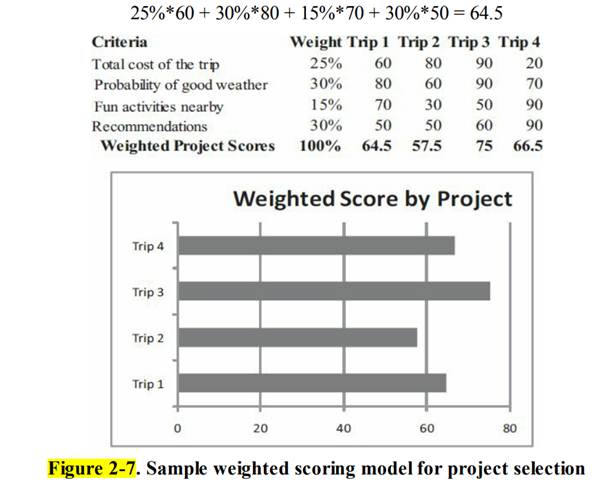
Develop criteria that your class could use to help select what projects to pursue for implementation by your class or another group. For example, criteria might include benefits to the organization, interest level of the sponsor, interest level of the class, and fit with class skills and timing. Determine a weight for each criterion, and then enter the criteria and weights into a weighted scoring model, similar to that shown in Figure 2-7. (You can use the template for a weighted scoring model provided on the companion Web site.) Then review the list of projects you prepared in Chapter 1, Team Project 3, and enter scores for at least five of those projects. Calculate the weighted score for each project. Write a one-to two-page paper or prepare a short presentation summarizing your results.

 
"Looking for a Similar Assignment? Get Expert Help at an Amazing Discount!"