solution

The local newspaper examined a town’s two hospitals and found that, over the last six years, Mercy Hospital had a patient survival rate of 79.0% while County Hospital’s survival rate was 90.0%. The following table summarizes the findings. Patients were categorized upon admission as being in fair condition (or better) versus being in worse than fair condition. a. The following table shows the survival numbers for patients admitted in fair condition: Fill in the last column for this table.
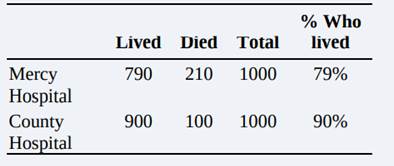
The local newspaper examined a town’s two hospitals and found that, over the last six years, Mercy...-1 The local newspaper examined a town’s two hospitals and found that, over the last six years, Mercy...-2

The following table shows the survival numbers for patients admitted in worse than fair condition: Complete the last column for this table.
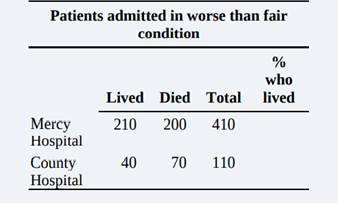
The local newspaper examined a town’s two hospitals and found that, over the last six years, Mercy...-3

c. The head of County Hospital argued that, based on the overall figures, her hospital came out well ahead of Mercy by 90.0% to 79.0% and, therefore, is doing a far better job. If you were head of Mercy Hospital, how would you respond? d. You are a parent trying to decide to which hospital to send your sick child. On the basis of the preceding three tables, which hospital would you choose? Explain.


"Looking for a Similar Assignment? Get Expert Help at an Amazing Discount!"

solution

An editorial in the Reno Gazette-Journal on February 1, 2015, addressed a major argument that critics used against Nevada Governor Brian Sandoval’s plan to raise taxes to improve Nevada’s public education system. The argument was that school funding has increased for years but performance hasn’t improved, so more money is not the answer. In particular, critics said that Nevada education funding has doubled since the 1960s but average student performance has remained flat. The editorial asserted that this reasoning is not correct. It went on to point out explicitly how Simpson’s paradox comes into play because the balance between white and Hispanic students has changed. a. The editorial used the following numbers for simplicity: Assume the number of students in Nevada to be only 100, both in 1960 and today. Suppose that in 1960, 90 students were white and 10 were Hispanic. In addition, suppose that 80% of white students graduated and 60% of Hispanic students graduated. What was the overall graduation rate in 1960? b. Suppose that the demographic has changed to be 50% white and 50% Hispanic today. Also assume that both groups improved: The graduation rate for white students increased to 88% , and the graduation rate for Hispanic students increased to 66%. What is the overall graduation rate now? c. Explain how your answers to parts a and b illustrate Simpson’s paradox.


"Looking for a Similar Assignment? Get Expert Help at an Amazing Discount!"
solution

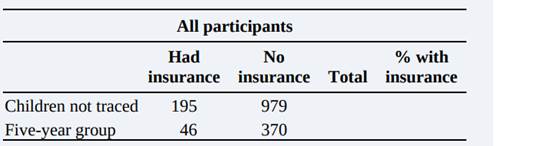
In 1990, scientists initiated a study of the development of children in the greater Johannesburg/Soweto metropolitan area of South Africa. 2 They collected information on certain children at birth, and five years later invited these children and their caregivers to be interviewed about health-related issues. Relatively few participated in the follow-up interviews, and the researchers wanted to know whether those who participated had similar characteristics to those who did not participate. In the following tables, these are referred to as the five-year group and the children not traced, respectively. One factor used to compare these groups was whether the mother had health insurance at the time the child was born. Here are the results for this factor, including only participants who were either white or black. a. Fill in the blanks in the preceding table. Round all percentages to whole numbers. b. In the summary of the cited study, the author noted, “If the five- year sample is to be used to draw conclusions about the entire birth cohort, the five-year group should have characteristics similar to those who were not traced from the initial group.” Are the percentages of those with insurance similar between the two groups in the table? If not, what conclusion would you draw on the basis of this quotation?

In 1990, scientists initiated a study of the development of children in the greater...


"Looking for a Similar Assignment? Get Expert Help at an Amazing Discount!"

solution

You are a purchasing agent. You always buy 1000 items from one source, namely 10 widgets and 990 doodads. In the past, widgets and doodads cost $1 each, so you paid $1000. Now the price of widgets has increased by 10% to $1.10, and the price of doodads has increased by 5% to $1.05. By how much has the total you pay increased? What percentage of $1000 is that increase? (This number is the percentage increase in the total paid.) Is it closer to 5% or to 10%? Explain how your answer to this third question is related to Simpson’s paradox.


"Looking for a Similar Assignment? Get Expert Help at an Amazing Discount!"